
Most Greater Vancouver homes need gutter cleaning at least twice a year: once in late fall after leaves drop and again in spring. Homes beneath tall trees may need three or four cleanings. No Monkey Biz has provided gutter cleaning Vancouver and exterior maintenance services across Greater Vancouver since 2012.
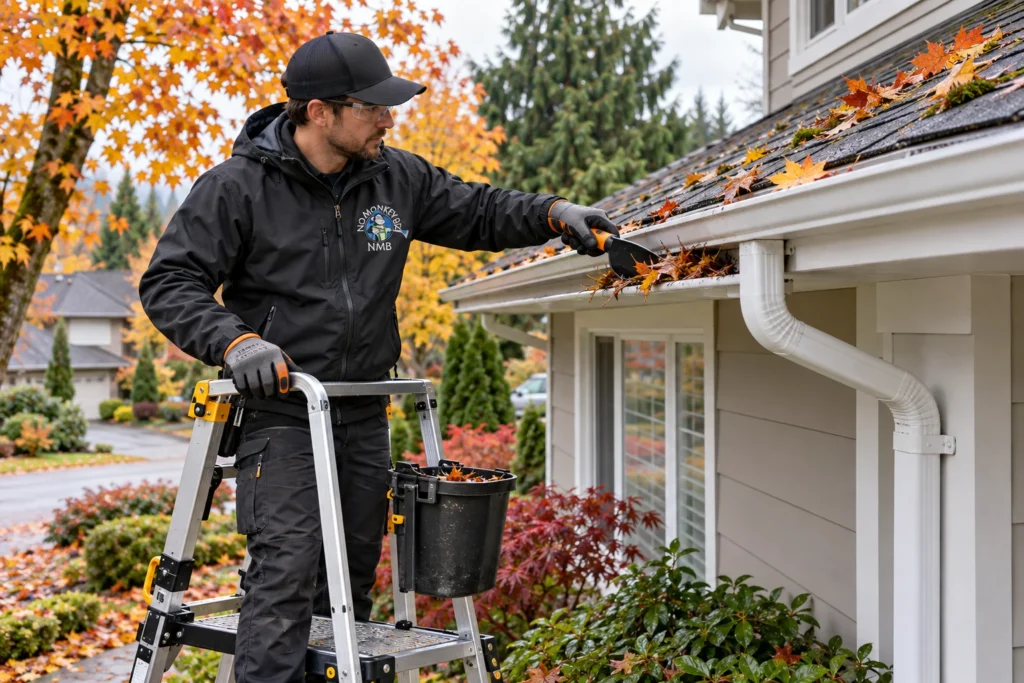
How Often Should Gutters Be Cleaned in Vancouver and the Lower Mainland?
Gutters in Vancouver and the Lower Mainland should generally be checked and cleaned at least twice a year. Late fall removes leaves and other debris before the wettest months, while spring cleaning clears material deposited by winter wind, rain, moss, and nearby trees. The Government of Canada recommends checking eavestroughs and downspouts at least twice per year, during fall and spring, and removing leaves, sticks, and other debris. It also advises homeowners to consider their safety when inspecting or cleaning these systems. Twice a year is a starting point, not a fixed schedule for every property. Homes below mature cedar, fir, maple, or other trees may need three or four cleanings. A property with little tree cover and an uncomplicated roof may remain clear for longer, but it should still be inspected.
The following table offers a practical starting schedule:
| Property condition | Suggested inspection or cleaning frequency | Useful times to check |
| Detached home with limited tree cover | At least twice per year | Spring and late fall |
| Home beneath mature trees | Three or four times per year | Spring, early fall, after leaf drop, and after major storms |
| North Vancouver or Maple Ridge property with dense tree cover | Three or four times per year, depending on buildup | Spring, fall, and after wind or heavy rain |
| Newer subdivision with young trees | At least twice per year | Spring and late fall |
| Older character home with a complex roofline | At least twice per year, with additional checks as needed | Spring, after leaf drop, and after storms |
| Strata or multi-unit property | Based on a documented maintenance schedule | Before the wet season and after major debris accumulation |
| Commercial property | Based on roof area, surrounding trees, access, and drainage demands | Scheduled inspections throughout the year |
These are planning ranges rather than guarantees. The appropriate schedule depends on the building, roof design, surrounding vegetation, gutter capacity, and how quickly debris returns after cleaning.
Why Do Lower Mainland Gutters Clog So Quickly?
Greater Vancouver combines frequent rainfall with extensive tree cover. Leaves, needles, seed pods, twigs, moss, roofing granules, and wind-blown debris can collect in gutters and around downspout openings. North Vancouver, Maple Ridge, Pitt Meadows, Langley, Coquitlam, and parts of Surrey contain many tree-lined neighbourhoods. Properties near parks, greenbelts, ravines, or wooded slopes may receive debris throughout the year instead of only during autumn. Older Vancouver and Burnaby homes may have additions, dormers, valleys, low roof sections, and several connected gutter runs. These features can direct a large amount of roof water and debris toward a small number of outlets.
Newer homes are not automatically free from gutter problems. Construction debris, nearby landscaping, roof granules, bird nesting material, and young trees can still create blockages. Coastal wind can also move debris onto properties in Richmond, Delta, and White Rock. A home without large trees directly beside it may still receive leaves and needles from neighbouring properties or nearby streets. Long periods of rain make partial blockages more noticeable. A gutter may appear to work during light rain but overflow during a prolonged storm because water cannot move through the downspout quickly enough.
What Signs Mean Your Gutters Need Cleaning Now?
Visible overflow is the clearest warning, but it is not the only sign. Gutters should be checked when water stops following its intended path from the roof to the downspout and away from the building.
Watch for these conditions:
- Water spilling over the gutter edge during rain
- Water escaping from a gutter joint or end cap
- Downspouts producing little or no flow during rainfall
- Leaves, moss, or plants visible above the gutter line
- Gutters sagging or pulling away from the fascia
- Dark streaks or staining below the gutters
- Water collecting beside the foundation or entrance
- Debris appearing at the bottom of downspouts
- Birds, insects, or other pests using accumulated material
- Water flowing onto stairs, decks, walkways, or neighbouring property
A lack of visible overflow does not prove that the system is clear. A downspout can be partly blocked while still allowing some water through. Look at the gutters from the ground during moderate rain when it is safe to do so. This can reveal overflowing corners, slow outlets, leaking joints, and water discharging in an unsuitable location. Do not climb a ladder during rain or high wind. If the gutters are difficult to see or reach, arrange an assessment instead of attempting to inspect them from the roof.
What Can Happen if You Skip Gutter Cleaning?
Blocked gutters can allow water to overflow near fascia boards, siding, windows, doors, walkways, landscaping, and foundations. The result depends on where the water travels and how long the problem continues. Repeated wetting may contribute to staining, peeling finishes, damp wood, or deterioration around roof edges. Water can also collect on stairs and walkways, creating inconvenient access conditions during cold weather. A blocked downspout may force water over the gutter edge or through a weak joint. If the outlet ends too close to the building, even a clear downspout may direct water toward the foundation instead of away from it. Canada.ca explains that properly maintained eavestroughs and downspouts collect roof runoff and direct it away from walls and foundations. Its flood-prevention guidance identifies regular gutter and downspout cleaning as one action homeowners can take to reduce preventable water problems.
The City of Vancouver also explains that blocked street catch basins can contribute to flooding, property damage, and unsafe conditions. Although a municipal catch basin is different from a home gutter, both are part of the wider route rainwater follows away from a property. During heavy leaf fall, homeowners can safely remove loose leaves from a nearby catch basin grate using an appropriate long-handled tool if conditions allow. The City recommends checking catch basins before and after heavy rain and when trees lose their leaves. Hazardous materials should be reported rather than handled.
Is Fall or Spring Better for Gutter Cleaning?
Fall and spring serve different purposes, so neither should automatically replace the other. Fall cleaning prepares the system for winter rain, while spring cleaning removes material left by winter weather. Late fall is especially important for homes beneath deciduous trees. Scheduling too early may leave the gutters full again after the final leaves drop. Evergreen trees create a different pattern. Cedar and fir needles may fall over a longer period, which means a property can require an early fall cleaning followed by another check later in the season.
Spring cleaning can remove roof moss, small branches, needles, and sediment moved by winter storms. It also provides an opportunity to observe whether gutters, downspouts, or extensions were loosened or damaged. Properties with heavy tree cover should not wait for a specific month if the gutters are already overflowing. Visible blockage, restricted downspouts, or water entering an unsuitable area should be assessed when noticed.
Do Gutter Guards Remove the Need for Cleaning?
Gutter guards can reduce the amount of larger debris entering a gutter, but they do not make the system maintenance-free. Needles, seeds, moss fragments, roofing granules, and fine organic material can still collect on or beneath the guard. Debris resting on top of a guard may stop water from entering the gutter evenly. In other cases, small material passes through openings and accumulates along the bottom of the gutter or around the downspout.
The Government of Canada notes that gutter guards can be installed, but it still recommends checking eavestroughs and downspouts at least twice per year. A guard changes how the system is inspected and cleaned rather than eliminating maintenance. Some guard systems are easy to lift or remove. Others require specialised handling to prevent bending, loosening, or damage. Before scheduling service, tell the contractor what type of guard is installed, if known. The written quote should clarify whether guard removal, cleaning beneath the guard, and reinstallation are included.
Is DIY Gutter Cleaning Safe?
Ground-level observation and basic cleanup around downspout outlets may be manageable for some homeowners. Working from a ladder or roof introduces additional risks related to height, uneven ground, overhead obstacles, wet surfaces, and equipment handling. Canada.ca advises homeowners not to work alone when checking eavestroughs and to inspect the area before climbing. It also recommends considering alternatives when conditions do not allow safe ladder use.
Professional help is worth considering when:
- The gutters are above one storey
- The property has steep or uneven ground
- The roof is wet, steep, or moss-covered
- A downspout blockage cannot be reached from the ground
- Gutters sit near electrical service lines
- Guard systems must be removed
- The building is part of a strata or commercial property
- Parking, residents, tenants, or public walkways affect access
- The homeowner cannot work from a ladder safely
A contractor should plan access before arriving. This can include identifying locked gates, narrow side yards, parked vehicles, roof hatches, hose connections, shared spaces, and areas that need to remain open. No Monkey Biz assesses the property before providing gutter cleaning and roof moss removal. Its written quote states what is included and excluded so the owner or manager can review the scope before scheduling.
How Do Local Conditions Affect Gutter Cleaning Frequency?
The basic recommendation is similar across Greater Vancouver, but local tree cover, exposure, housing type, and property access can change the schedule.
Langley
A home on a larger lot may have mature trees, detached garages, sheds, and several gutter systems. Owners looking for gutter cleaning in Langley should identify every structure they want included in the quote.
Surrey
Surrey includes established tree-lined neighbourhoods, newer subdivisions, townhome communities, and commercial properties. Gutter cleaning in Surrey should be scheduled according to the individual property rather than the age of the neighbourhood alone.
Richmond
Richmond’s relatively flat landscape makes it important to check where downspouts discharge after the gutters are cleared. Property owners arranging gutter cleaning in Richmond should note any areas where water collects near entrances, walkways, or foundations.
North Vancouver
Dense trees, sloped lots, complex access, and long wet periods can lead to faster debris buildup. Gutter cleaning in North Vancouver may require more frequent service where branches extend above the roof.
Maple Ridge
Homes near wooded areas and greenbelts can receive leaves, needles, moss, and small branches throughout the year. A Maple Ridge gutter cleaning schedule may include additional checks after heavy wind or rainfall.
How Much Does Gutter Cleaning Cost in Greater Vancouver?
Gutter cleaning cost in Vancouver depends on the property rather than one standard rate. Building height, gutter length, roof design, tree cover, access, guards, debris volume, and blocked downspouts can all affect the work.
Common cost factors include:
| Cost factor | Why it affects the quote |
| Building height | Taller buildings may require different access planning and equipment |
| Gutter length | Longer systems take more time to inspect and clear |
| Roof complexity | Valleys, additions, dormers, and multiple levels can complicate access |
| Debris volume | Heavy leaves, moss, sediment, or plant growth take longer to remove |
| Downspout blockage | A blockage may require additional work beyond open-gutter cleaning |
| Gutter guards | Some systems must be removed or opened before cleaning |
| Property access | Narrow side yards, slopes, locked areas, and parking affect setup |
| Additional structures | Garages, sheds, canopies, and outbuildings may need separate inclusion |
| Roof moss | Moss removal is a related but separate service that may change the scope |
A useful quote should state which buildings and gutter sections are included, whether downspouts will be checked, whether guards are included, how debris will be handled, and what repairs are excluded. It should also identify access requirements before the service date.
Frequently Asked Questions
How Often Should Gutters Be Cleaned in Vancouver?
Most Vancouver and Lower Mainland homes should have their gutters checked and cleaned at least twice a year, usually in spring and late fall. Homes beneath mature trees may require three or four cleanings, depending on how quickly leaves, needles, moss, and other debris accumulate.
Is Fall or Spring Better for Gutter Cleaning?
Both seasons are useful. Late-fall cleaning removes leaves before prolonged winter rain, while spring cleaning clears debris left by winter storms and provides an opportunity to check for loose or damaged components.
Do Gutter Guards Stop Clogs Completely?
No. Gutter guards may reduce larger debris, but needles, seeds, moss fragments, roofing granules, and fine material can still collect on or beneath them. Gutters and downspouts should continue to be inspected and cleaned as needed.
How Much Does Gutter Cleaning Cost in Greater Vancouver?
The price depends on building height, gutter length, roof design, debris volume, access, downspout blockages, and whether guards or additional structures are included. Request a written quote that clearly explains the scope instead of comparing prices without knowing what each service includes.
Request a Free Quote
To request a free quote, send the property address, property type, approximate building height, number of structures, known gutter problems, and photographs if available. Use the No Monkey Biz contact form or call 604-307-8323. No Monkey Biz has served Greater Vancouver since 2012. The team assesses the property, provides a written quote stating what is included and excluded, plans access before scheduling, and reviews the completed work.