
In BC, the people who occupy or control a property, such as owners, strata corporations, landlords, and some tenants, are expected to take reasonable care to keep it reasonably safe for visitors, and that includes managing snow and ice. Most Lower Mainland cities also require the sidewalk next to a property to be cleared by a set deadline after snowfall. A written snow plan, arranged before winter, is the most practical way to meet both expectations.
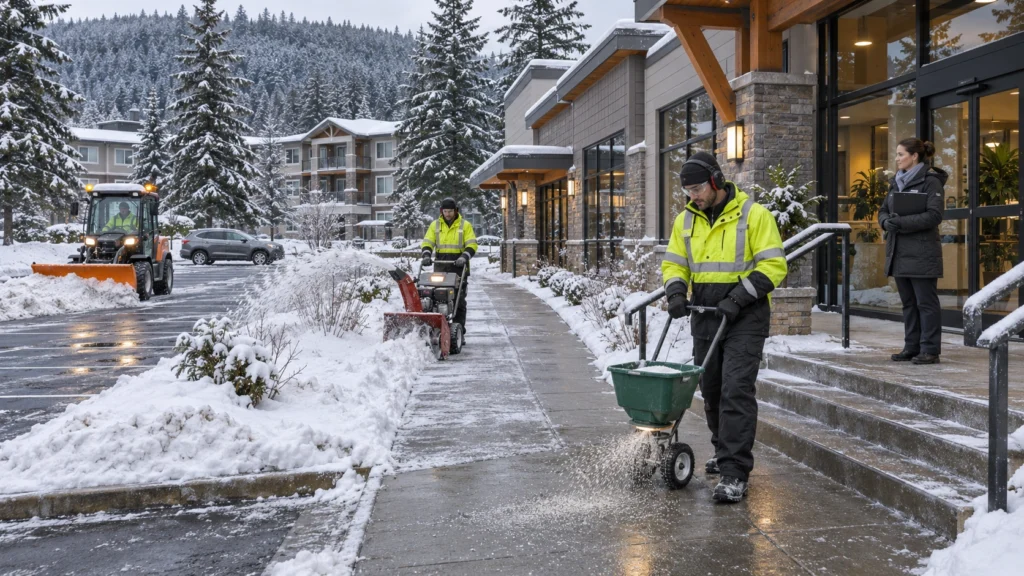
Commercial snow removal in Vancouver is different from places with long, steady winters. Snow here can be unpredictable, and when it arrives it often comes with freezing rain or a melt-and-refreeze cycle that turns walkways to ice overnight. No Monkey Biz, a Greater Vancouver property maintenance company serving the Lower Mainland since 2012, provides commercial snow removal and de-icing for businesses, strata buildings, and managed properties. This guide explains who is responsible, what local rules say, and what a good snow plan should include.
This article is general information, not legal advice. Speak with a lawyer or your insurer about your specific obligations.
Who Is Responsible for Snow and Ice Removal on Commercial and Strata Properties in BC?
Responsibility usually depends on who controls the area.
| Property Situation | Usually Responsible |
| Owner-occupied commercial building | The owner |
| Leased commercial space | Depends on the lease: owner, tenant, or shared |
| Strata building common property (entrances, walkways, parkade ramps) | The strata corporation, acting through the council |
| Strata limited common property (e.g. some patios or balconies) | Depends on the strata’s bylaws and arrangements |
| Public sidewalk next to the property | The adjacent owner or occupant, under municipal by-laws |
| Contracted service | The contractor performs the work in the agreement; the property contact still oversees it |
The BC Government’s strata guidance says strata corporations must maintain and repair common property, which commonly includes entrances, walkways, and parkades. For leased commercial spaces, check the lease for who handles snow and ice.
What Does BC’s Occupiers Liability Act Mean for Snow and Ice?
BC’s Occupiers Liability Act sets out the duty owed by an “occupier” to people who come onto a property. The Act defines an occupier as someone who is in physical possession of the premises or has responsibility for and control over them. A property can have more than one occupier, such as an owner and a commercial tenant.
Under section 3, an occupier “owes a duty to take that care that in all the circumstances of the case is reasonable to see that a person, and the person’s property, on the premises… will be reasonably safe.” That duty covers the condition of the premises, which includes snow and ice on entrances, walkways, and parking areas.
The Act doesn’t require a property to be perfectly free of ice at all times. What counts as reasonable depends on the circumstances, including the weather, the type of property, and how many people use it. BC courts have considered the steps an occupier took. For example, a BC Real Estate Association summary of 1990s cases describes a restaurant owner who hired a contractor to inspect and sand a parking lot daily and checked that the work was done. The court found that the owner had taken reasonable care.
The practical takeaway is to have a plan, follow it, and keep records.
How Soon Must Sidewalks Be Cleared in Vancouver and Nearby Cities?
Most Lower Mainland cities require property owners or occupants to clear snow and ice from the public sidewalk next to their property. Deadlines and fines vary by city:
| Municipality | Sidewalk Clearing Deadline | Fines (where stated) |
| City of Vancouver | By 10 a.m. each day when there is snow on sidewalks or freezing temperatures | $250; up to $750 if snow and ice remain for over 24 hours |
| Burnaby | By 10 a.m. the day after a snowfall | $100 (single-family), $250 (multi-family), $400 (industrial, commercial, institutional) |
| Surrey | Before 10 a.m. after a snowfall | $55 per day (residential), $80 per day (business) |
| Richmond | By 10 a.m. every day (industrial, commercial, and multi-family buildings) | Not stated |
| Coquitlam | Within 10 hours after a snowfall | Not stated |
| City of North Vancouver | Within 24 hours after snow stops falling or ice forms | Not stated |
| West Vancouver | Within 24 hours | Not stated |
| City of Langley | Within 24 hours, or before snow builds up past 10 cm | Not stated |
| Abbotsford | Within 24 hours after snow stops falling or ice forms | Not stated |
Rules can change, so check your city’s current by-law at the start of each winter. If your property is in another municipality, such as the Township of Langley or the District of North Vancouver, check that city’s website for its deadline.
What Should a Commercial Snow and Ice Plan Include?
A written plan sets expectations before the first snowfall and makes the response faster when it arrives. It should cover:
- Service areas: Which entrances, sidewalks, walkways, stairs, ramps, loading zones, and parking areas are included, ideally marked on a site map.
- Priority order: Which areas are cleared first, such as main entrances and accessible routes.
- Triggers: When service starts, for example a forecast, a set snow depth, or freezing conditions.
- De-icing: Which products will be used on which surfaces, and when.
- Snow storage: Where cleared snow will go without blocking drains, entrances, fire routes, or sight lines.
- Timing: Expected response windows, especially before business opening hours.
- Contacts: Who to call on site and after hours.
- Records: How visits, conditions, and products used will be logged.
Salt or Alternatives: Which De-Icer Should You Use?
The right de-icer depends on the surface, the temperature, and what’s nearby. Rock salt is common and inexpensive, but it can be hard on concrete, landscaping, and pets’ paws, and it leaves residue that’s tracked indoors. Other products may work better on sensitive surfaces or at colder temperatures.
When choosing a de-icer, consider:
- Surface type: New concrete, pavers, natural stone, and wood decks may need gentler products.
- Nearby landscaping and drains: Runoff from de-icers can affect plants and drainage areas.
- Foot traffic: High-traffic entrances may need more frequent application.
- Indoor tracking: Residue tracked inside can damage flooring and mats.
Always follow the product label. Your contractor should explain which products they use and why.
Once winter ends, de-icer residue and grime on walkways and entrances can be removed with spring commercial pressure washing.
Why Drainage and Refreezing Matter
In the Lower Mainland, many icy-surface problems come from water, not snow. Melting snow, roof runoff, and overflowing gutters can run across walkways and freeze overnight.
During the pre-season review, identify:
- Areas where water collects or flows across walkways
- Downspouts that empty onto paths or parking areas
- Blocked drains or catch basins
- Shaded spots that stay icy longer
A snow service can clear and treat the agreed areas, but it can’t fix grading or drainage problems. Keeping gutters clear before winter helps meltwater drain away. See our guide on how often to clean gutters in Greater Vancouver.
How Do You Choose a Snow Removal Contractor?
Ask potential contractors:
- Which areas will be cleared and treated, and in what order?
- What triggers a service visit, and how quickly do you respond?
- Which de-icing products do you use on each surface?
- How do you record visits and conditions?
- Do you carry liability insurance and WorkSafeBC coverage?
- Who is the contact during a snow event?
- How is cleared snow stored on site?
The answers should go into the written agreement, so everyone has the same expectations before the season starts.
Strata Buildings: Extra Points to Plan
Strata properties have some extra considerations:
- Confirm which areas are common property and which are limited common property or owner responsibility.
- Tell residents what the service covers and when.
- Keep parkade ramps, accessible routes, and garbage and recycling areas in the plan.
- Coordinate around resident parking so snow can be cleared and stored.
For individual homes and rentals, see residential snow shovelling and de-icing.
Snow Removal Across the Lower Mainland
No Monkey Biz, a Greater Vancouver property maintenance company since 2012, provides commercial snow removal and de-icing for businesses, strata buildings, and managed properties across the region, including Langley and Abbotsford. We assess the site before the season and set out the service areas, triggers, and de-icing plan in writing.
Frequently Asked Questions
Who is liable for slips on a strata sidewalk in BC?
It depends on who controls the area and what steps were taken. Strata corporations must maintain common property, and BC’s Occupiers Liability Act expects occupiers to take reasonable care to keep visitors reasonably safe. This is general information only; speak to a lawyer or your insurer about a specific situation.
How soon must sidewalks be cleared in Vancouver?
The City of Vancouver requires property owners and occupants to clear snow and ice from the full width of the sidewalk by 10 a.m. Surrey and Burnaby also use a 10 a.m. deadline, while some cities, such as West Vancouver and Abbotsford, allow 24 hours. Check your city’s current by-law each season.
Does rock salt damage concrete?
Rock salt can be hard on some concrete, especially newer or porous surfaces, and on landscaping and pets’ paws. Gentler products may be better for sensitive surfaces. Follow the product label and ask your contractor which de-icers they use on each surface.
What should a snow removal contract include?
A snow removal contract should list the service areas, priority order, service triggers, response times, de-icing products, snow storage locations, contacts, and how visits are recorded. Putting these in writing before winter sets clear expectations for everyone.
Request a Free Quote
The best time to plan snow and ice service is before the first forecast. Send us your property address, the type of property, the areas you want covered, and any known icy or drainage problem spots. A site map or photos can help.
Request a free quote online or call 604-307-8323.