In BC, high-rise window cleaning falls under WorkSafeBC’s Occupational Health and Safety Regulation, mainly Part 11 (Fall Protection), Part 13 (work platforms such as swing stages), and Part 34 (Rope Access). In practice, that means fall protection when a fall of 3 m (10 ft) or more is possible, two independent ropes for rope access, certified workers, a written plan, and permanent roof anchors certified by a professional engineer.
Many online answers about window cleaning safety describe Ontario’s rules, which have their own regulation for window cleaning. This guide focuses on British Columbia. No Monkey Biz, a Greater Vancouver exterior cleaning company serving the Lower Mainland since 2012, provides high-rise window cleaning with IRATA/SPRAT-certified technicians. Below, we explain the main rules, the common access methods, and what building owners and strata councils should ask before hiring.
This article is general information, not legal or safety-compliance advice. Always refer to the current WorkSafeBC Regulation and guidelines.
What Safety Regulations Must High-Rise Window Cleaners Follow in Canada?
Workplace safety in Canada is mostly regulated by each province, which is why the rules for window cleaning in Ontario differ from those in BC.
- Ontario has a regulation written specifically for window cleaning, Regulation 859 under the Occupational Health and Safety Act. It covers equipment such as boatswain’s chairs and rope access, and requires building owners to have anchor points and permanently installed suspended scaffolds inspected.
- British Columbia does not have a separate window-cleaning regulation. Window cleaning falls under WorkSafeBC’s Occupational Health and Safety Regulation, mainly:
- Part 11 (Fall Protection): when fall protection is required, fall protection plans, and anchor strength
- Part 13 (Ladders, Scaffolds and Temporary Work Platforms): work platforms, including swing stages, suspended platforms, and elevating or boom-supported platforms
- Part 34 (Rope Access): two-rope systems, worker certification, rope access plans, anchors, and rescue
For some higher-risk suspended platform setups, Part 13 requires written certification from a professional engineer. It refers to CSA Z271 (the safety code for suspended platforms) and CSA Z91 (the health and safety code for suspended equipment operations).
If your building is in BC, ask contractors how their work meets WorkSafeBC requirements, not Ontario’s.
When Is Fall Protection Required in BC?
Under Part 11 of the WorkSafeBC Regulation:
- Fall protection is required where a worker could fall 3 m (10 ft) or more, or where a shorter fall could cause injury greater than landing on a flat surface (section 11.2).
- Guardrails or similar fall restraint must be used when practicable. Where they aren’t practicable, the regulation steps down to other fall restraint, then fall arrest or rope access, then procedures acceptable to WorkSafeBC.
- A written fall protection plan is required where a fall of 7.5 m (25 ft) or more may occur and there are no permanent guardrails (section 11.3). The plan must be available at the workplace before work begins.
Almost all high-rise window cleaning takes place well above these heights, so a fall protection system and a written plan are standard.
What Does WorkSafeBC Require for Rope Access Window Cleaning?
Rope access, sometimes called abseiling or rappelling, is one of the most common methods for high-rise window cleaning. Part 34 of the Regulation sets out the rules. Key requirements include:
- Two-rope system: Workers must use two independent ropes, a working line and a safety line, each with its own anchor connection (section 34.6).
- Certification: Workers must hold a valid certificate from a recognized body, such as IRATA (Industrial Rope Access Trade Association) or SPRAT (Society of Professional Rope Access Technicians). The certificate must be available at the workplace (section 34.4).
- Written rope access plan: A plan covering hazards, the rope system and anchors, inspection procedures, team roles, equipment, and rescue must be prepared before work begins (section 34.3).
- Rescue: The employer must make sure a worker can be promptly rescued if something goes wrong (section 34.8).
- Equipment checks: Rope access equipment must be inspected before first use each shift (section 34.10).
What Are the Requirements for Roof Anchors?
Anchors are the connection points that ropes and fall protection systems attach to. For building owners, they’re often the most important part of the conversation.
Under the WorkSafeBC Regulation:
- Permanent fall protection anchors must be able to withstand at least 22 kN (5,000 lbs) and be certified by a professional engineer (sections 11.6 and 11.8).
- Permanent rope access anchors must have an ultimate load capacity of at least 22.2 kN per connected person, be inspected and tested at least once a year with the results documented, and be certified by a professional engineer (section 34.12).
- A permanent anchor that doesn’t meet the requirements must not be used until it has been inspected and recertified by a professional engineer (section 11.10).
Who Is Responsible for Anchors?
Responsibility is shared between the building owner and the contractor:
- Building owners: Under section 25 of BC’s Workers Compensation Act, an owner of a workplace must maintain their land and premises so that people working there are kept safe. They must also give the employer or prime contractor any information they know about that is needed to identify and control hazards. WorkSafeBC’s Part 34 guidelines, drawing on CSA Z91, say the engineer who inspects the anchors should give the building or equipment owner signed and sealed inspection reports.
- Contractors: Before each work shift, the person using the rope access system must inspect the equipment, including the anchors (section 34.10). They should also review the building’s anchor records before starting.
- Records: Inspection, testing, and servicing results should be kept in an equipment log, with the engineer’s reports filed alongside it. WorkSafeBC’s guidelines also note that anchors installed with adhesive or expansion fasteners need load testing at least every five years, witnessed by a professional engineer or a qualified person under their supervision.
In practice, building owners and strata councils should keep anchor certification and inspection records on file, book the annual inspection, and share the records with contractors before work begins.
What Access Methods Are Used for High-Rise Window Cleaning?
| Access Method | How It Works | Often Used For |
| Rope access | Certified technicians descend on two independent ropes from roof anchors | High-rise towers, buildings without a BMU, complex facades |
| BMU (building maintenance unit) | A permanent, building-mounted cradle system that moves along the roof and facade | Large towers designed with a BMU |
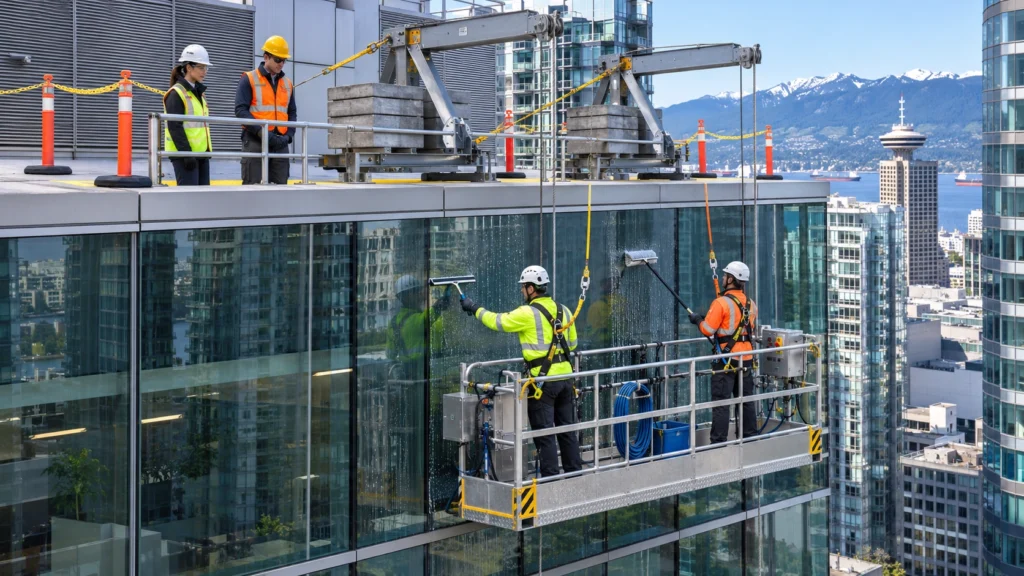
| Swing stage (suspended platform) | A temporary platform suspended from the roof by cables | Long, flat facades and larger crews |
| Boom lift or aerial work platform | A mobile lift that reaches upper floors from the ground | Low- and mid-rise buildings, storefronts, atriums |
The right method depends on the building’s height, design, roof anchors, ground access, and the work required. A building with a BMU may still need rope access for areas the BMU can’t reach.
What Should Building Owners and Strata Councils Ask a Window Cleaning Contractor?
Before hiring a high-rise window cleaning contractor, ask:
- Which access method will you use, and why?
- Are your technicians certified? Ask for IRATA, SPRAT, or equivalent certificates for rope access.
- Will you provide a written fall protection or rope access plan for this building?
- What is your rescue plan?
- What do you need from us about roof anchors? Share anchor certification and inspection records.
- Do you carry liability insurance and WorkSafeBC coverage? Ask for a WorkSafeBC clearance letter.
- How will you protect people below? Ask about work zones, signage, and pedestrian control.
- How will residents or tenants be notified?
- What happens if weather or wind conditions change?
A professional contractor will be able to answer these questions clearly and in writing.
How Does Weather Affect High-Rise Window Cleaning?
Wind, rain, and cold all affect high-rise work. Strong wind can make suspended work unsafe, and wet or icy surfaces add risk on the roof. In the Lower Mainland, many buildings schedule high-rise window cleaning for drier months, with flexible dates in case conditions change.
High-Rise Window Cleaning Across Greater Vancouver
No Monkey Biz, a Greater Vancouver exterior cleaning company since 2012, provides high-rise and strata window cleaning across the region, including Burnaby, Richmond, and North Vancouver. Our IRATA/SPRAT-certified technicians assess each building before confirming the access method, and the written quote sets out the scope, access plan, and any limitations. For a full year of building maintenance, see our strata exterior maintenance planning guide.
Frequently Asked Questions
What regulations apply to high-rise window cleaning in BC?
High-rise window cleaning in BC falls under WorkSafeBC’s Occupational Health and Safety Regulation, mainly Part 11 (Fall Protection), Part 13 (Ladders, Scaffolds and Temporary Work Platforms), and Part 34 (Rope Access). These cover when fall protection is required, written plans, work platforms, two-rope systems, worker certification, anchors, and rescue.
What is a BMU in window cleaning?
A BMU, or building maintenance unit, is a permanent cradle system mounted on a building’s roof that moves along the facade so workers can clean windows and maintain the exterior. Many large towers are designed with one, though rope access may still be needed for areas the BMU can’t reach.
Do window cleaners need IRATA certification in BC?
For rope access work, WorkSafeBC requires workers to hold a valid certificate from a recognized body, and the Regulation lists organizations including IRATA and SPRAT. Other access methods, such as swing stages or boom lifts, have their own training requirements.
Who is responsible for roof anchor inspections?
Building owners and contractors share responsibility. Permanent rope access anchors must be inspected and tested at least once a year and certified by a professional engineer, and WorkSafeBC guidance says the engineer’s signed inspection reports go to the building owner. The contractor must also inspect the anchors before each shift.
Request a Free Quote
Every high-rise building has its own access requirements. Send us your property address, the building height and number of storeys, the type of roof anchors or BMU on site, and the glass you want cleaned. Anchor certification records and building photos help with the initial review.
Request a free quote online or call 604-307-8323.